Special Session
Special Session on
AI-Driven Advances in Medical Imaging: From Deep Learning to Clinical Deployment -
ADAMI
2026
20 - 21 May, 2026 - Benidorm, Spain
Within the 6th International Conference on Image Processing and Vision Engineering - IMPROVE 2026
*** THIS SATELLITE EVENT WAS CANCELLED ***
CHAIR
|
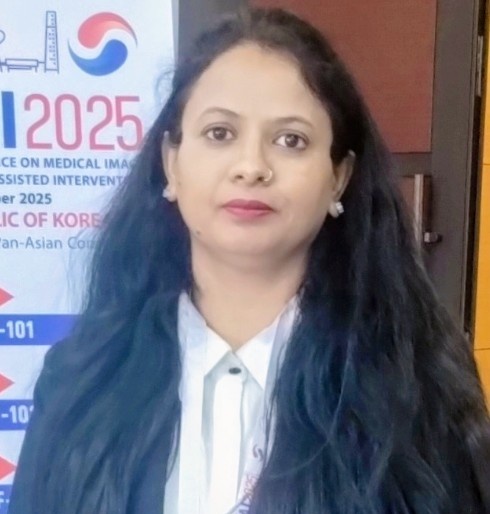
Deepika Koundal
University of Eastern Finland
Finland
|
|
|
|
Brief Bio
Dr. Deepika Koundal is an accomplished AI researcher with over 14 years of academic experience, specializing in artificial intelligence, computer vision, image processing, and deep learning. She currently serves as a Senior Researcher at the University of Eastern Finland and holds a Ph.D. in Computer Science and Engineering. Dr. Koundal has been honored with numerous recognitions, including the prestigious MSCA Seal of Excellence from the European Commission and placement among Stanford University’s World’s Top 2% Researchers in both 2023, 2024 and 2025. She received the Best Paper Award from Elsevier’s Journal of Visual Communication and Image Representation (2023), and holds honorary membership from the Neutrosophic Science Association, University of Mexico, USA. She was also selected as a Young Scientist at the 6th BRICS Conclave Young Scientist Forum in 2021. In addition to multiple research excellence awards from UPES and Chitkara University, she has edited several notable books, contributed extensively to leading journals, and serves as an author, guest editor, and associate editor.
|
SCOPE
Medical imaging has become a cornerstone for diagnosis, prognosis, treatment planning and monitoring across many disease areas. In recent years, advances in artificial intelligence (AI) particularly deep learning, multimodal fusion (imaging + clinical + genomic data), and imaging-based survival modeling are dramatically transforming the field.
This special session aims to bring together researchers and practitioners who are pushing the frontier of AI in medical imaging: developing novel methods, addressing translational challenges (e.g., robustness, generalisation, interpretability, regulatory issues), and reporting real-world clinical studies.
The session will highlight both methodological innovation (e.g., novel architectures, self-supervised learning, representation learning, survival modelling) and impactful applications (e.g., imaging for oncology, cardiology, neurology; multimodal fusion; imaging biomarkers). We aim to create a forum bridging advanced technical tasks.
TOPICS OF INTEREST
Topics of interest include, but are not limited to:
- Deep Learning Architectures for Medical Image Segmentation, Classification, Detection
- Multimodal Fusion of Imaging (MRI, CT, PET, Ultrasound) with Clinical, Genomic or Multi-omics Data
- Self-supervised, Semi-supervised and Unsupervised Learning Applied to Medical Imaging
- Transfer Learning, Domain Adaptation, Robustness and Generalization in Medical Imaging AI
- Explainability, Interpretability and Uncertainty Quantification in Medical Imaging AI
- Imaging Biomarkers and AI-driven Phenotyping
- Survival Modelling and Prognostic Prediction Using Imaging Features (e.g., Using Cox, DeepSurv, etc)
- Real-world Clinical Trials, Validation Studies, Regulatory/Ethical Considerations of AI in Medical Imaging
IMPORTANT DATES
Paper Submission:
March 24, 2026 (expired)
Authors Notification:
April 7, 2026 (expired)
Camera Ready and Registration:
April 15, 2026 (expired)
SPECIAL SESSION PROGRAM COMMITTEE
Available soon.
PAPER SUBMISSION
Prospective authors are invited to submit papers in any of the topics listed above.
Instructions for preparing the manuscript (in Word and Latex formats) are available at: Paper Templates
Please also check the Guidelines.
Papers must be submitted electronically via the web-based submission system using the appropriated button on this page.
PUBLICATIONS
After thorough reviewing by the special session program committee, all accepted papers will be published in a special section of the conference proceedings book - under an ISBN reference - and abstracted/indexed in DBLP, Google Scholar, EI-Compendex, INSPEC, Japanese Science and Technology Agency (JST), Norwegian Register for Scientific Journals and Series, Mathematical Reviews, SCImago, Scopus and zbMATH. CCIS volumes are also submitted for the inclusion in ISI Proceedings.